Our method:
Construction
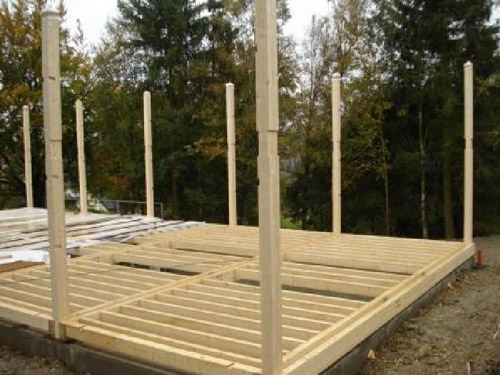
"For centuries, people have been building houses with posts and beams." A post-and-beam building consists of large wooden posts and beams that together form a skeleton with a very open structure. Unlike timber-frame construction, the structure is in itself strong and self-supporting, even without wind bracing. Stability is further ensured by the interior walls added later.
The posts are generally made in one piece from the ground up to the roof. With the beams you can create large spans, sometimes even from the front to the back facade, without intermediate supports.
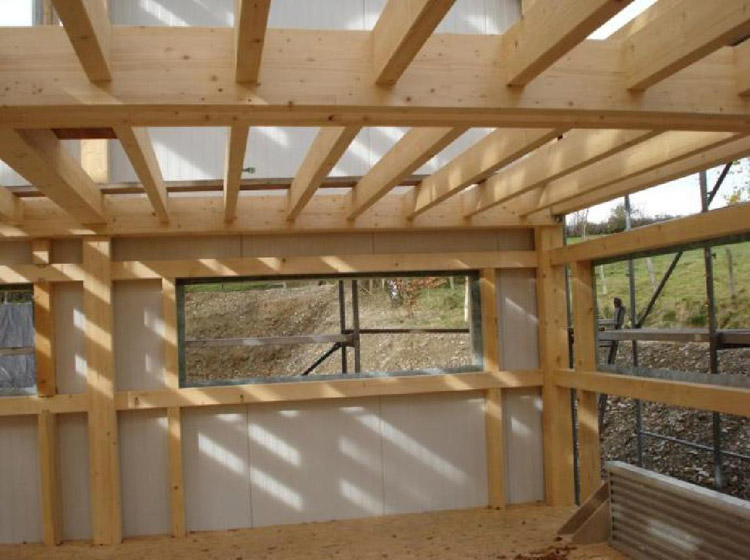
For both the post-and-beam structure and the roof truss we use glued laminated timber, because it offers more stability and is cheaper to produce. Of the three timber construction methods, post-and-beam is the most open system. It also offers the greatest architectural freedom. The robust skeleton makes it possible to create large window openings and open spaces with high ceilings, and gives flexibility in laying out the interior. (no load-bearing walls)
2. Sandwich panels
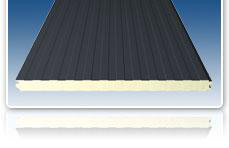
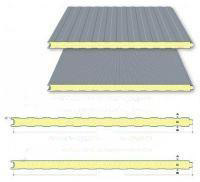
A sandwich panel is a panel consisting of a steel plate, sprayed with PUR (polyurethane foam) and another steel plate.
Properties:
- Sandwich panels are self-supporting. No separate structure is required
- Sandwich panels are easy to dismantle without dust-generating operations
- Sandwich panels are washable and therefore easy to maintain
- When used as a ceiling, sandwich panels are walkable
- Cut-outs (passages, windows, doors, etc.) can be made easily.
- Finishing is done with the same steel sheet as the panels
- Length is always made to measure; width between 1000 and 1200 mm
Insulation values of PUR
- core density: min. 30 kg/m³
- foamed density: approx. 40 kg/m³ ± 5 kg/m³
- practical lambda value: 0.0213 W/mK
- practical K-value: 0.29 W/m²K
3. Assembly techniques
Berger&Bildt has developed an assembly technique that enables us to guarantee a high level of air tightness in the building.